Introduction
Hundreds of candidates, many different clients, lots of open positions, interviews, and so much more go through the hands of the recruitment agency on a daily basis. Manually dealing with these things can take plenty of time and inhibit productivity during hiring.
A recruit software CRM streamlines each of these processes by having everything alongside a single candidate and keeping track of every client along with automating processes and enhancing recruitment efficiency.
The recruitment CRM software can also be equipped with AI technology to enable recruiters to match candidates to jobs, evaluate resumes, automate communications, and more, using their data.
In addition to standard features, Eduzent can provide tailor-made CRM development with sophisticated artificial intelligence features to help companies delve into different software options that suit their recruitment process.
What is a CRM for a Recruitment Agency?
These are things that a recruitment CRM software can help recruitment firms with. These are the elements that recruitment CRM software could aid recruitment companies in handling with the sources platform.
It can enable recruiters to:
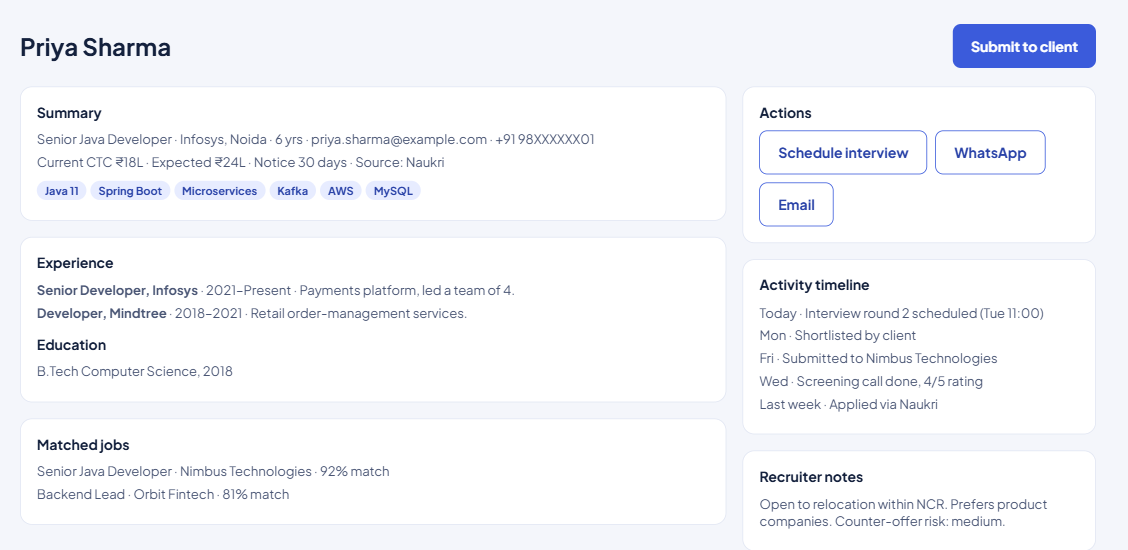
Administer a "heads in one place" candidate database.
Work with clients and hiring needs.
Monitor job vacancies, candidates' pipelines.
Send automated follow-up emails and correspondence.
Organize and conduct interviews and review feedback.
Use analytics to track recruitment performance.
When compared to a regular CRM, recruitment CRM software is directed particularly at the needs of staffing firms, recruitment firms, and talent acquisition teams.
Why is CRM important for recruitment agencies?
Recruitment CRM software for an agency is used to efficiently run the processes of agencies and boost their recruitment agency productivity.
1. Centralized Candidate Management
Keep all resumes, contacts information, skills, qualifications and employment histories in one searchable database.
2. Better Client Relationships
Store the requirements, communication trail, follow-ups and business opportunities of the client at a single location.
3. Faster Candidate Shortlisting
Practice advanced search and AI to help match with job specifications.
4. Automated Recruitment Workflows
Find repetitive tasks such as sending emails, interview reminders, and so on can be automated.
5. Improved Recruitment Productivity
Minimize administration so that recruiters can concentrate on engaging the candidate and securing the client.
6. Data-Driven Decisions
Track placements, recruiter performance, recruitment timelines and recruitment revenue through dashboards and reports.
Key Features of Recruitment CRM Software
The best recruitment CRM will be able to support the entire recruitment process.
1. Candidate Database Management
Keep candidate portfolio, résumés, skills, experiences, certifications and communications.
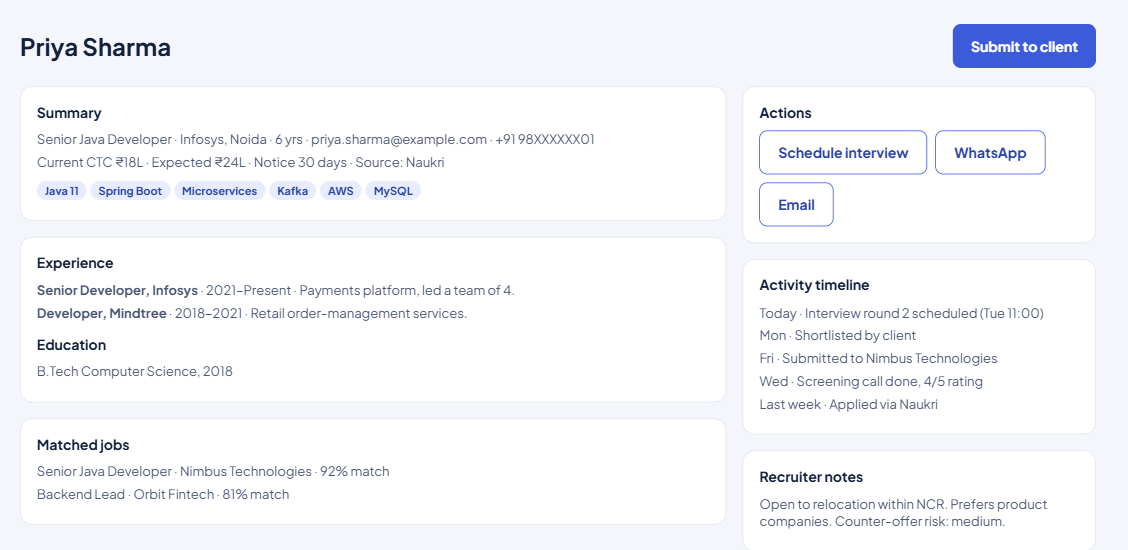
2. Client Relationship Management
Handle company profiles, hiring managers, company needs, contracts, and follow up with clients.
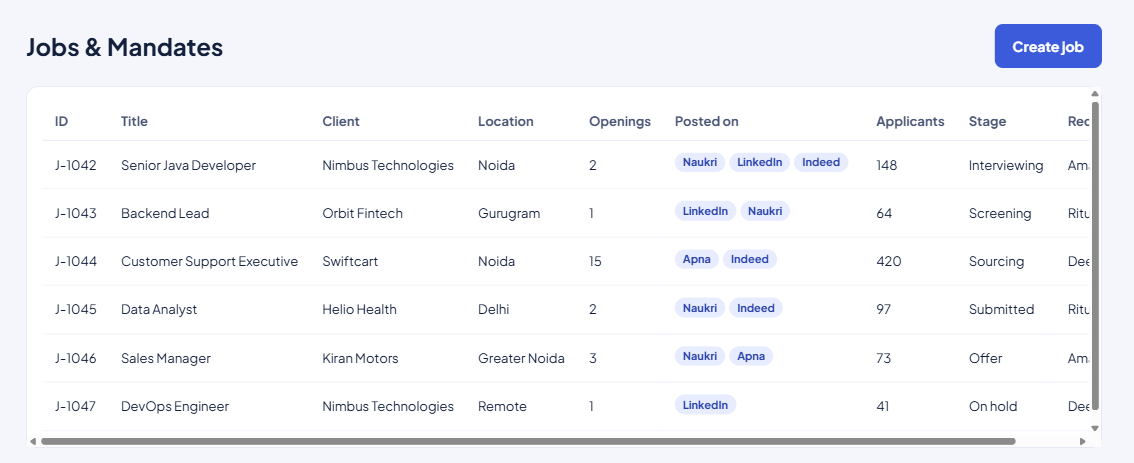
3. Job and Vacancy Management
Post jobs, set requirements, designate recruiters for jobs, and monitor job status.
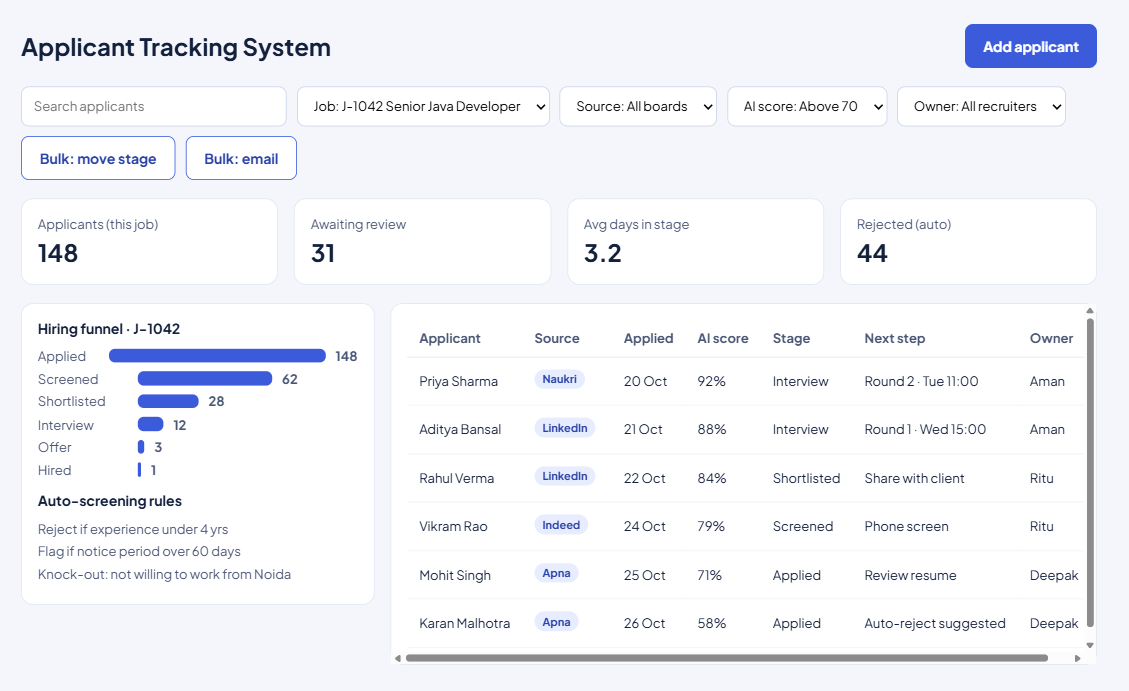
Applicant Tracking System (ATS)
Track candidates during screening, shortlisting, interviewing, reservation/provisional offers, and placement.
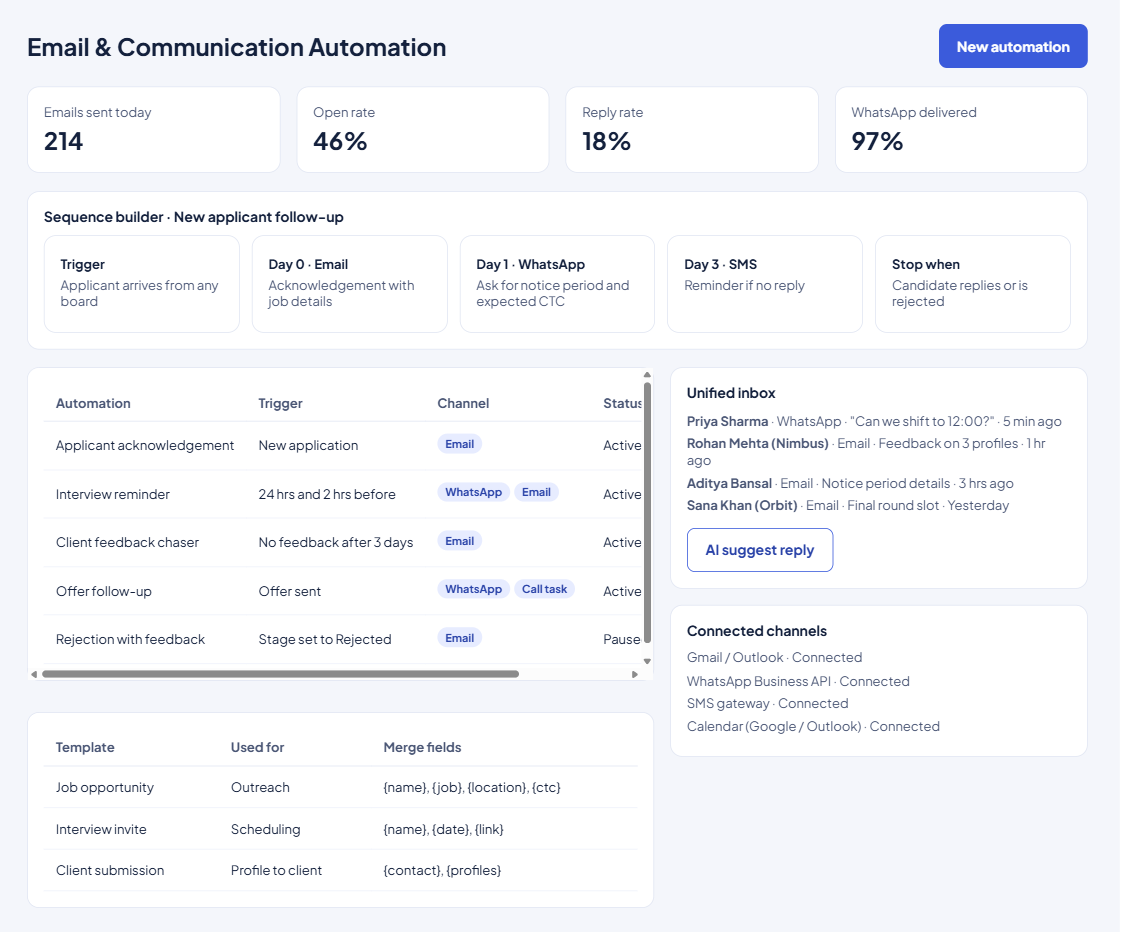
5. Email & Communicaton Automation
Automate candidate outreach, interview invital, reminders and follow-ups.
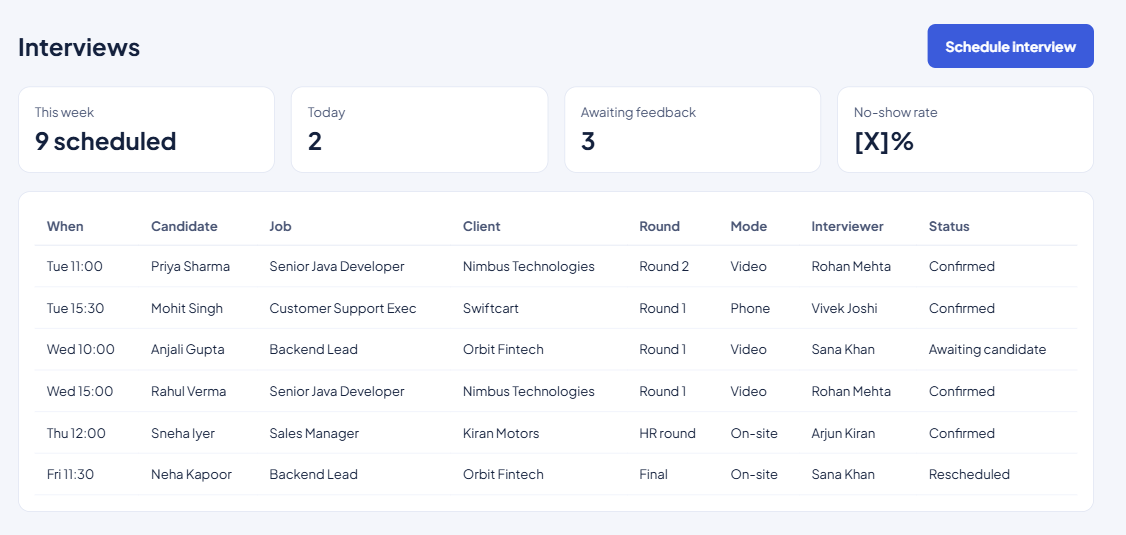
6. Interview Scheduling
Schedule, track, receive feedback, and track candidate statuses.
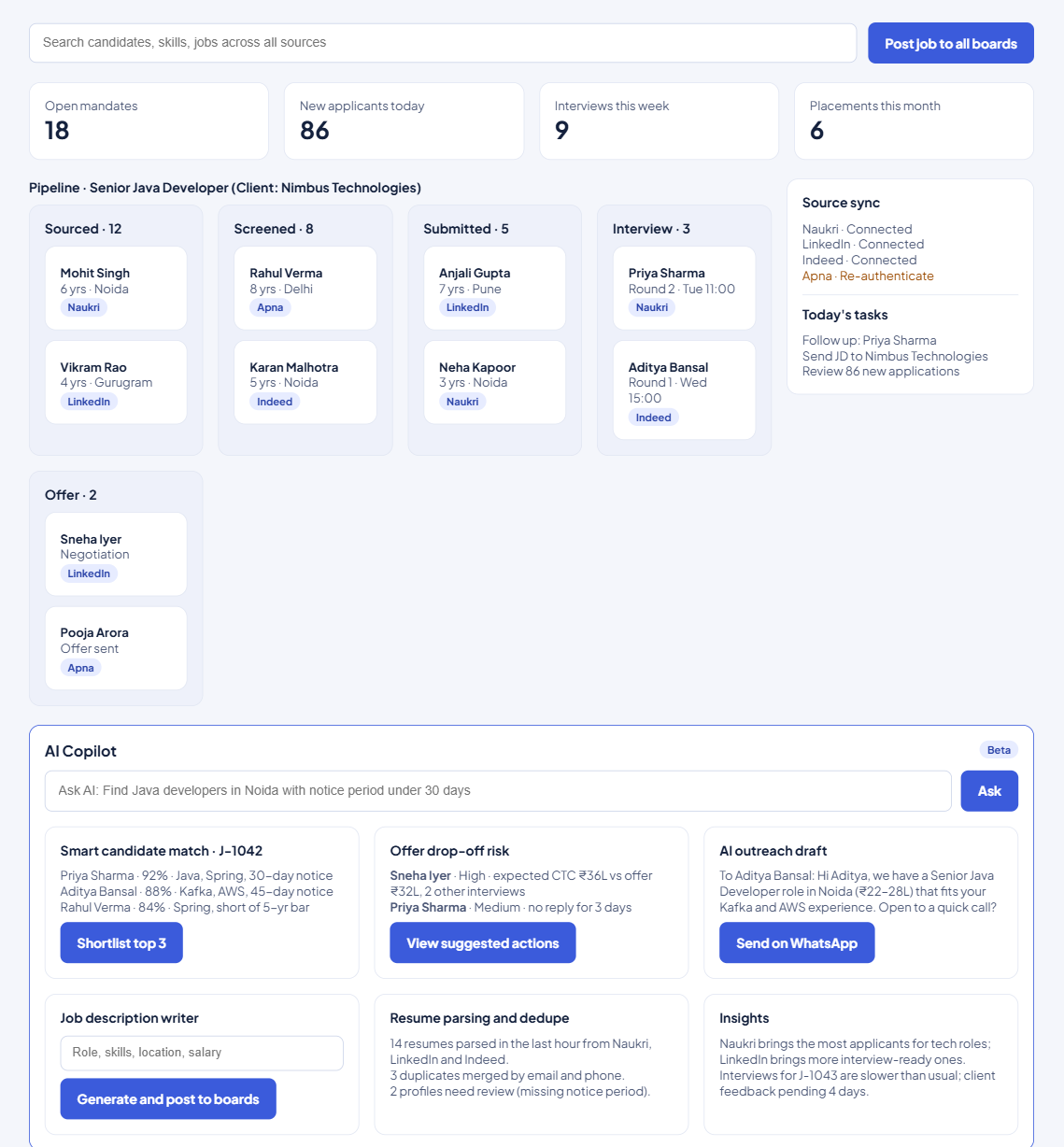
7. Recruitment Pipeline Management
Monitor and track candidates through a configurable recruitment funnel and pinpoint delays.
8. Reporting and Analytics
Track the time to fill, placement ratings, acceptance of offers, recruiter productivity and client performance.
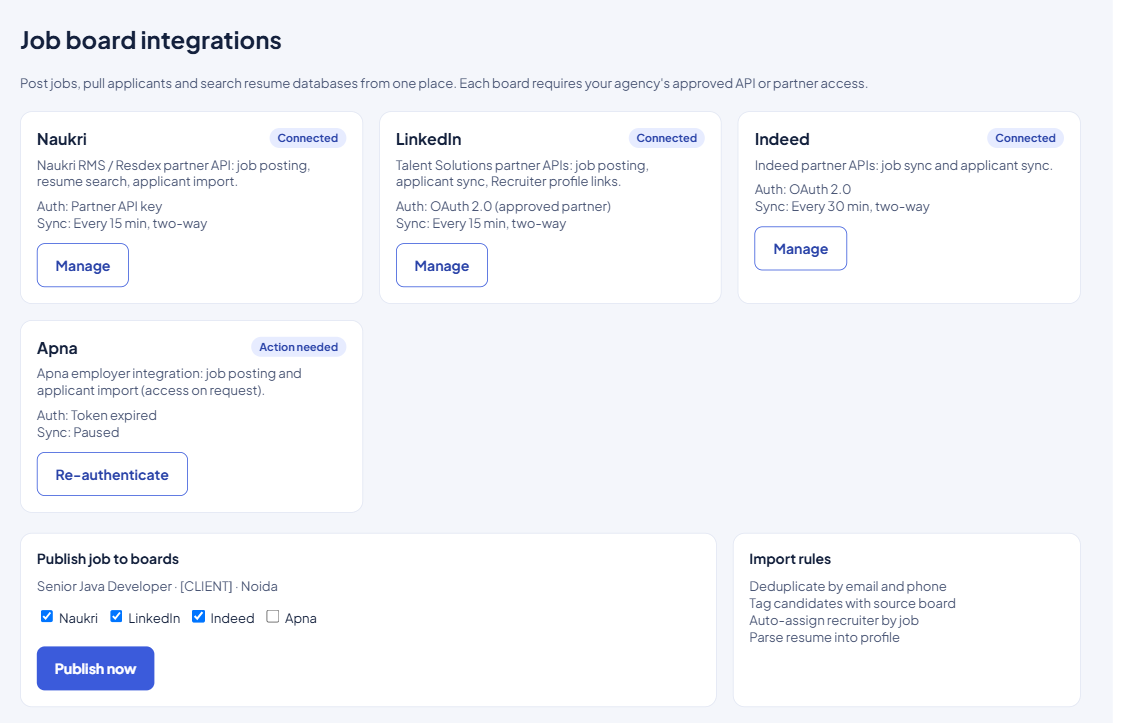
9. Third-Party Integrations
Integrate the CRM to email providers, calendar, job portals, resume parsing and accounting systems if supported.
11. Quality and Security Controls
Secure and safeguard important candidate data with role-based permissions and secure authentication methods, audit logs, and proper data retention policies.
How AI Is Transforming Recruitment CRM Software?
AI-powered recruitment CRM systems enable agencies to enhance their operation, automate repetitive processes, and make it easier to analyze the data of candidates.
1. AI-Powered Candidate Matching
Examine the abilities, background, and other credentials that applicants possess in order to decide if they might be candidates for available positions.
2. AI Resume Parsing
Screen resumes and record relevant candidate data in searchable resumes.
3. Intelligent Candidate Search
Apply contextual search to find relevant candidates, instead of focusing only on keywords.
4. AI-Generated Job Descriptions
Create and update job descriptions, taking into account the needs of the job, skills and experience.
5. Automated Candidate Communication
Help create individual emails, invitation to interview, and follow-up correspondence.
6. AI Recruitment Chatbots
Respond to standard candidate inquiries, gather initial data and facilitate interview arranging.
7. Predictive Recruitment Analytics
Review Hiring by the Numbers data history to find common trends and challenges.
8. AI-Powered Reporting
Natural-language summarize to recruit performance and enable managers to explore business metrics.
AI should enhance the decision-making process for recruiters, not replace it. Data for employment purposes, such as candidate matching, should be checked for correctness and for bias.
There are several advantages to implementing custom CRM, such as:Custom CRM Development offers a number of benefits, including:
As every agency has their own specific needs, off-the-shelf recruitment software might not do the job. A recruitment CRM solution can offer more flexibility.
Key benefits include:
Tailor-made workflows: Design processes according to the work in the recruitment process.
Integrated with advanced AI features as needed for business.
Seamless integrations: Link in current business application and database.
Flexible Reporting: Configure dashboards to align with your agency's KPIs.
Scalability: Add new capabilities and processes as they need.
More control: Organize features based on the needs of your business.
While custom development always involves a greater upfront cost, it can be extremely beneficial if it is engineered around a specific operational need.
How to Select the Leading Recruitment CRM Development Firm?
Choosing the right development partner will determine the development of a strong and dependable recruitment CRM.
Before deciding consider following points:
CRM Development Experience: Assess skills and proficiencies in custom software and database management.
AI tools: validate with resume parsing, candidate matching, automation.
Resource recruitment abilities: Make certain that the group is knowledgeable in staffing and recruitment processes.
Integration capabilities: talk about how it will fit in with what you currently have.
Security standards: Review on data access control and data security measures.
Development process: Seek a clear project scope, schedule and outcomes.
Continued support: Ensure maintenance, updates, and post launch support.
The requirements assessment process will provide a blueprint for finding a partner who is right for your business.
Why opt for Eduzent to build a Custom Recruitment CRM?
Software that fits into the recruitment agency workflow is essential, as it does not impose on them pre-defined processes.
Eduzent is an excellent firm to take advantage for custom CRM development that incorporates advanced possibilities involving AI. You should decide if it's an applicable tool for your recruitment project based on the requirements of your project.
Custom CRM Solutions
Review and understand CRM capabilities specifically for candidate management, client relationship, Job tracking and recruitment pipeline.
Advanced AI Capabilities
Assess various integration options including AI-enabled candidate matching, automated interpretation of resumes, enhanced search capabilities, and automated communication.
Workflow Automation
Facilitate repetitive recruitment processes with customizable workflows, notifications and follow up automation.
Custom Dashboards
Schedule reporting based on the performance among recruiters, placement rates, productiveness of the recruiters, and the expansion of the enterprise.
Third-Party Integrations
Discuss integration with applications such as email, calendar, job portals and other business applications.
Scalable Development
Develop an approach that can change when your recruitment operations and technology needs change.
Prior to development, the final scope, the functionality of the AI, the time and costs, must be discussed with Eduzent.
Are you on the hunt for a custom recruitment CRM?
Speak with Eduzent about what you need and see how they have a solution aligned to your recruitment processes.
Agencies and independent job boards can also leverage their recruitment software to drive results, by adhering to best practices, such as:
Success in implementing an automated CRM system depends on proper planning and CRM adoption.
Describe your needs: State recruitment problems and critical elements.
Prepare existing data: Preprocess candidate records to eliminate duplicates and clean and prepare records.
Monitor to-priority integrations: Link the tools that your recruiters use the most.
Enable team members: Make sure recruiters are familiar with system and how it works.
Measure performance: Be able to monitor the number of KPIs for recruitment pre and post implementation.
Evaluate AI's results: Accessibility of accuracy and ensure human supervision.
Secure candidacy information: Use relevant privacy and security measures.
Regularly checking on it is great to ensure that the CRM continues meeting the evolving needs of your agency.
Conclusion
A recruitment agency CRM enables companies to manage candidates more efficiently, foster better client connections, automate processes, and boost the performance of the recruitment efforts.
Resume parsing, intelligent candidate matching, and predictive analytics are just a few of the AI-powered features that can further streamline recruiter productivity.
If you're looking for a custom CRM with advanced AI features for your agency, you should consider using Eduzent.
The selection of the right solution begins with understanding your workflows in recruiting, defining features that are suitable, and choosing a partner for its long term development who would support your long term goal of the business.
Frequently asked questions
Quick answers to the most common questions about this topic.
A recruitment CRM program is software made use of by firms to take care of applicant data, connections, open placements, communication, as well as recruitment pipelines from a solitary platform.
For those requiring a tailored CRM system, Eduzent with its enhanced features of artificial intelligence might be a good option. Before choosing, consider and weigh its suggested functions, past experience, costs, security measures and continued service.
Yes. The AI-powered CRM can analyze stellar candidate skills, experience and qualifications against job needs and find candidates that may exhibit the necessary skills. The suggestions will be helpful for recruiters to check before choosing.
Custom CRM apps are ideal for agencies’ unique workflows and integrations. Software that is already developed is preferable for businesses that have little budget for software development at the start and may have standard requirements.
AI can be used to match candidates, write resumes, improve search capabilities, assist in communication, measure recruitment results, and automate procedures.